OEE (Overall Equipment Effectiveness). How to measure machine utilization effectively?
Proper use of the machine park is one of the key aspects of building value in manufacturing companies. High operational efficiency of production machines translates into higher profits with the same resources. To optimize the work of production machines, it is worth starting by measuring the current efficiency of the production system. This is what…

Baumalog
05 / 03 / 2024
Proper use of the machine park is one of the key aspects of building value in manufacturing companies. High operational efficiency of production machines translates into higher profits with the same resources. To optimize the work of production machines, it is worth starting by measuring the current efficiency of the production system. This is what the OEE (Overall Equipment Effectiveness) indicator was created for. In the article below, we explain its importance, how it is calculated and how it is used in practice.
OEE: the three basic components of the indicator
OEE (Overall Equipment Effectiveness) is a measure that shows to what extent machines are used in the production process. The OEE indicator can apply to various types of machines: laser cutters, press brakes, automated bending cells and many other machines used by companies depending on their needs.
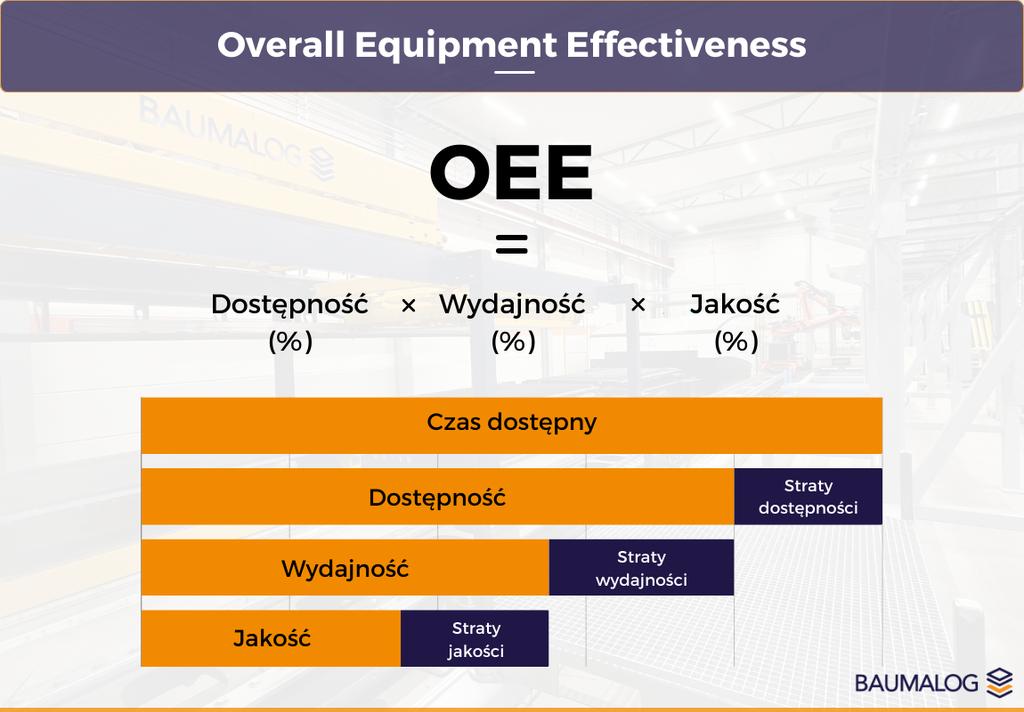
The efficiency of their use is shown by the OEE indicator, which combines three key measures:
- Availability,
- Performance,
- Quality.
How to calculate OEE? An example calculation
To better illustrate the indicator, let us look at a simple example of calculating OEE. Suppose a manufacturing company with a laser cutter processes raw metal sheets in order to pass the cut parts on to the next production stage. The OEE calculation based on the available production data looks like this.
Availability
The company’s production plant operates 24 hours a day. Due to technical downtime, breaks and operator shift changes, the machine was available for only 21 hours.
Availability = (21 hours / 24 hours) * 100% = 87.5%
Performance
Average production output was 12 production units per hour, while the theoretical maximum output is 18 units per hour.
Performance = (12 units / 18 units) * 100% = 66.7%
Quality
For quality reasons, 3% of the parts cut from metal sheets were unfit for further processing.
Quality = 100% of cut parts – 3% of rejected parts = 97%
With data on availability, performance and production quality, we can calculate the OEE indicator. Based on the available data, it shows to what extent the machines are used in the production process.
OEE Overall Equipment Effectiveness = 87.5% x 66.7% x 97% = 56.6%
The conclusion from this result is that due to the machine’s low performance and availability, the company uses only 56.6 percent of its potential. This is well below production capacity.
The benchmark for this example is the reference OEE value, also called “World Class OEE”, which is at least 85%. This result is possible assuming machine availability of 90%, performance of 95% and production quality of 99%.
OEE: how to increase machine utilization? The role of automation
A production machine such as a laser cutter can work continuously, with breaks for maintenance, for example. With an automation module installed, the machine always has raw material delivered on time and finished parts collected on an ongoing basis. As a result, there is no downtime caused by waiting for material. Not needing an operator to serve the machine constantly increases its availability, because production can continue even if the operator is unavailable or doing other tasks in the production hall.
Fully automatic loading and unloading of the laser cutter eliminates the manual work the operator has to do repeatedly. A laser cutter automation system such as SmartFlow System from Baumalog provides much higher efficiency than, for example, a pillar jib crane, which requires the operator’s presence and additional human actions.
Thanks to automation, machine park efficiency (OEE) can increase to as much as 90% by improving the availability and performance of production machines.
Besides making full use of the machine park, automating a processing machine improves the operator’s ergonomics. Safety is ensured by eliminating physical work when loading and unloading heavy and sharp parts. Ensuring maximum machine park efficiency and creating specialized positions for production staff is the key to a company’s success today.
What benefits can OEE analysis and ongoing efficiency monitoring bring to a company?
The OEE indicator makes it possible to identify areas of the production process that need improvement. When operations run continuously, paying attention to certain parts of the production process can be demanding. Ongoing monitoring of machine utilization with the OEE indicator helps eliminate production bottlenecks. As a result, the whole process can achieve higher operational efficiency. Making full use of the potential of the existing machine park reduces unnecessary costs and provides a basis for building a strong competitive position on the market.
Looking for a solution to help optimize the work of a laser cutter or another processing machine in your company? Send us basic information about your machine park and production needs, and our team will select the right solution for your process.
For more interesting information, follow our channels: