How do you get material from an automated storage system to the machine?
An automated storage system solves the storage problem: material is stored vertically, every shelf is within reach, and the forklift stops circling the hall. But there is another question: how do you deliver the material to where it is needed?

Baumalog
06 / 08 / 2026
An automated storage system solves the storage problem: material is stored vertically, every shelf is within reach, and the forklift stops circling the hall. But there is another question: how do you deliver the material to where it is needed?
Sometimes the answer is simple, because the laser is two meters from the storage system. In other cases, the material has to travel several or several dozen meters, sometimes across an open part of the hall. In one of our projects, the station track is as long as 100 meters.
As the distance grows, it is not just the travel time that changes. Questions come up about power supply, whether the track will cross a traffic route, and how to secure the route. That is why we do not choose the transport method from a catalog: we match it to the specific process and hall layout.
Below we describe the transport of whole shelves, most often with metal sheets, although we apply the same principles to profiles, tubes and boards. What happens to the material once it arrives (manual retrieval, overhead crane, loader) is the next stage of the process and deserves its own post.
The simplest option: collecting the shelf right at the storage system
If the machine or workstation is next to the storage system, a separate transport system may not be needed. The shelf can be presented on the lift or transferred onto a fixed table.
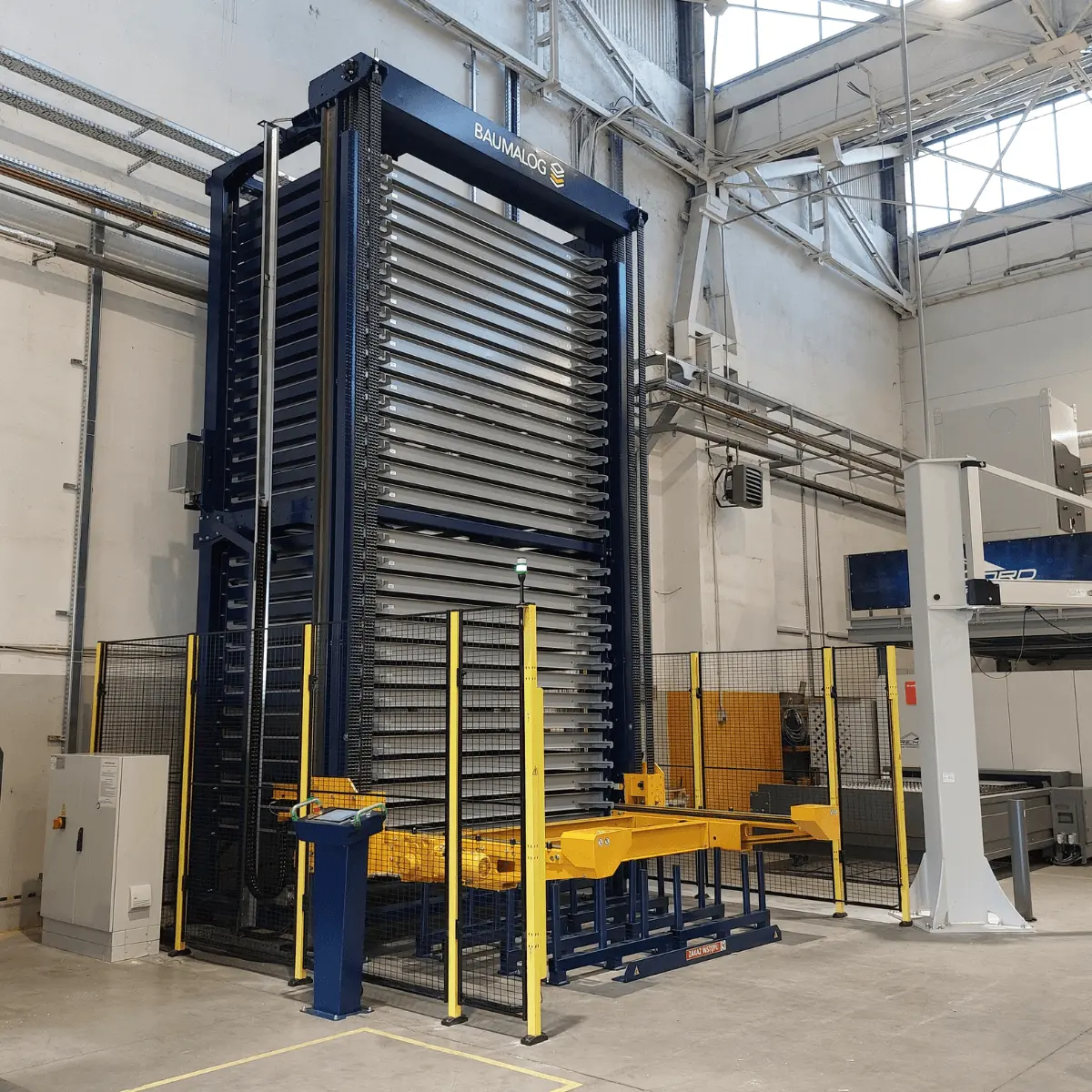
The first solution is typical of the MonoTower system. The operator calls up a shelf from the panel, the lift places it at the access point, and the material stays within the machine footprint. No station, no track in the floor.
Example project
The storage system for 90 t of sheet metal at Rekord Hale Namiotowe was placed close to the laser cutter, so sheets go onto the machine table directly from the lift using a small jib crane. The bottoms and walls of the shelves are covered with ABS so as not to scratch the sheets, which with thin sheets is not just a cosmetic detail.
The alternative is a fixed table next to the storage system. The shelf moves out to a prepared spot, and the material is taken by the operator, an overhead crane or another automated machine.
There is one catch: the storage system has to stand close to the workstation it serves. Not every layout allows this, and moving a laser cutter is rarely an option.
The station: a shelf that leaves the storage system
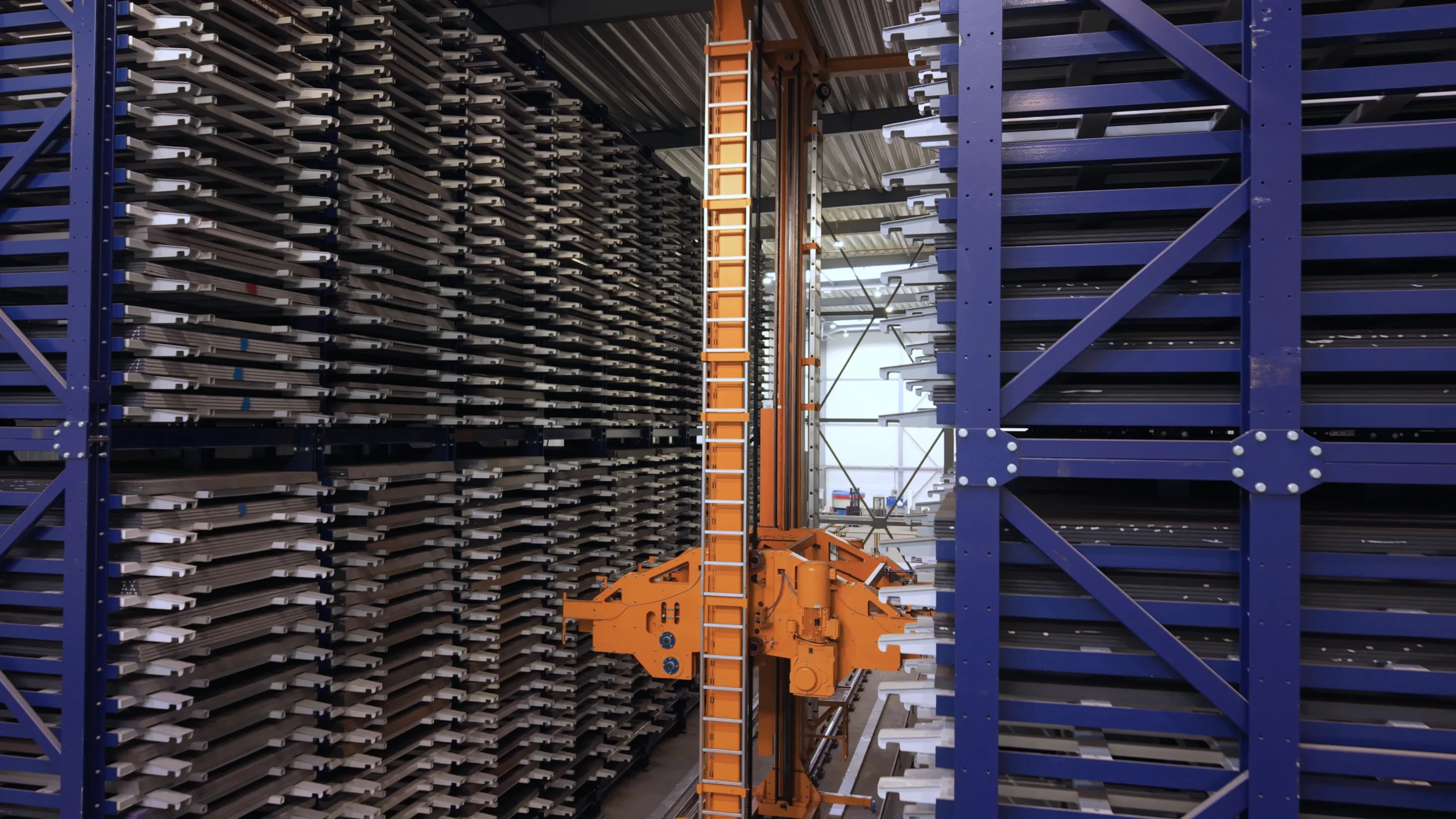
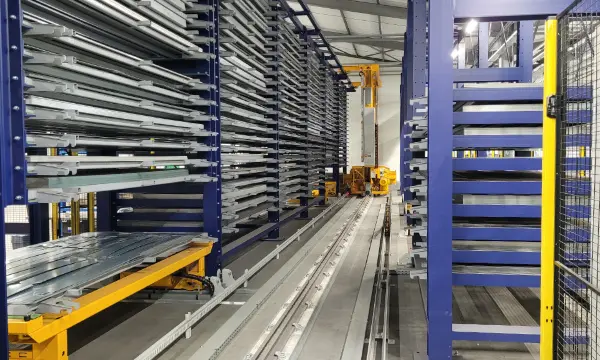
When material has to move away from the rack, the loading and unloading station comes in. It is a movable carriage running on a track, onto which the lift places a whole shelf. The station takes it to the point where material is retrieved or replenished and returns for the next one.
In a standard layout, the station moves out far enough for the whole shelf to be outside the storage system footprint, giving the operator convenient access. Depending on how the rack is positioned, it can move out along the short or the long side of the shelf.
We usually use the short side for a local pickup point. The layout takes up little space along the storage system and works well for loading and manual access to material.
The long side makes it easier to run transport along the storage system or further towards the machine. The direction alone does not determine the distance, but in practice this is the option we use most often for longer routes.
Example project
This can be seen clearly at Invest-Rem, where a TwinTower stores over 80 tons of profiles up to 6 meters long. The station runs on a track built into the floor and can move out on both sides of the storage column, which made it possible to separate the goods receiving area from the area where raw material is issued to production. The result: access to any item in the storage system in 3 minutes, regardless of whether the forklift is free at that moment.
Is the machine further away? We extend the track
Since every station runs on a track anyway, we do not change the operating principle for longer distances. We extend the same track and set a stop closer to the workstation.
The station still moves along a fixed route and stops at repeatable points, at the storage system and at the machine. The track can be flush with the floor, so forklifts drive over it without bumps.
Example project
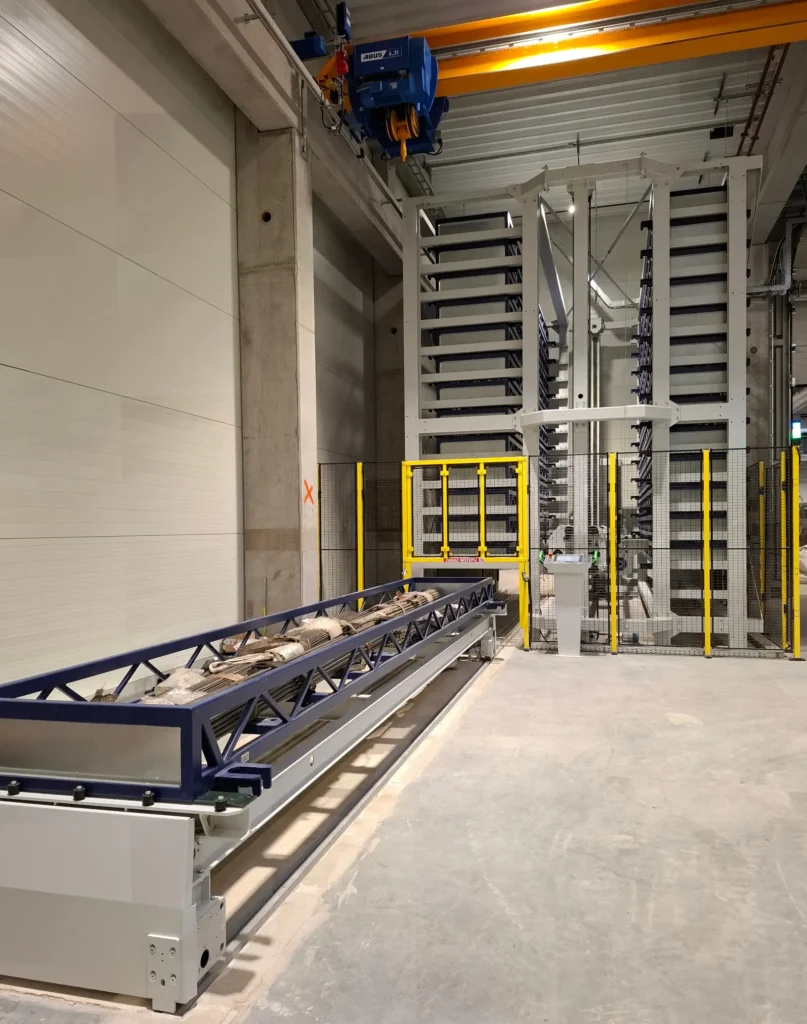
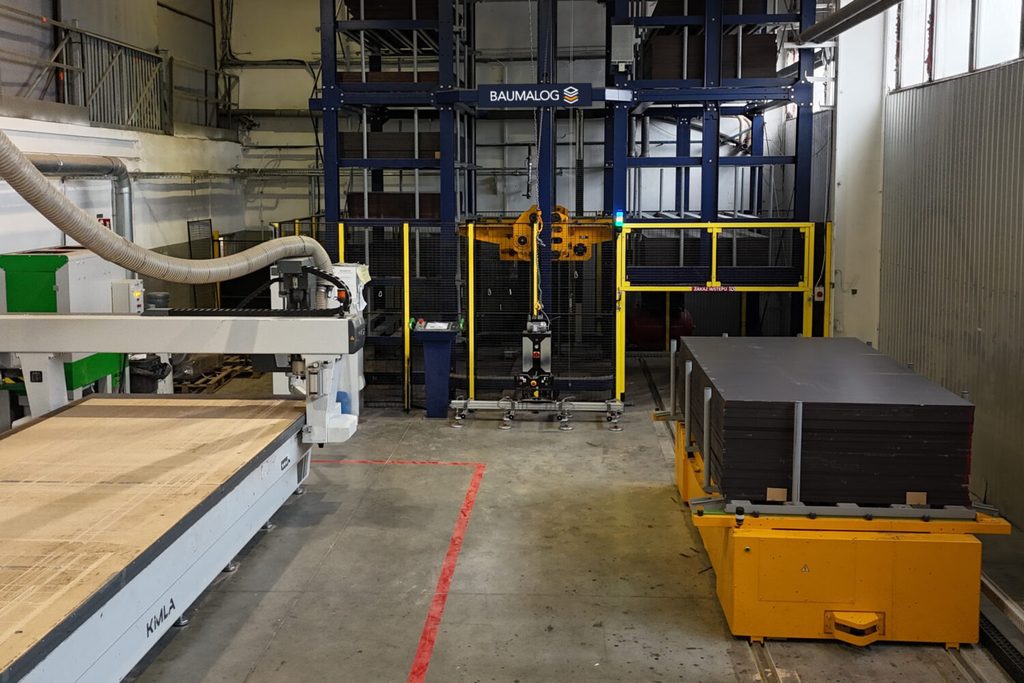
The TwinTower rack at Temared stores over 26 tons of plywood. The station runs on a track over 13 meters long between two stops: one at the KIMLA milling plotter and the other at the loading point for whole packages.
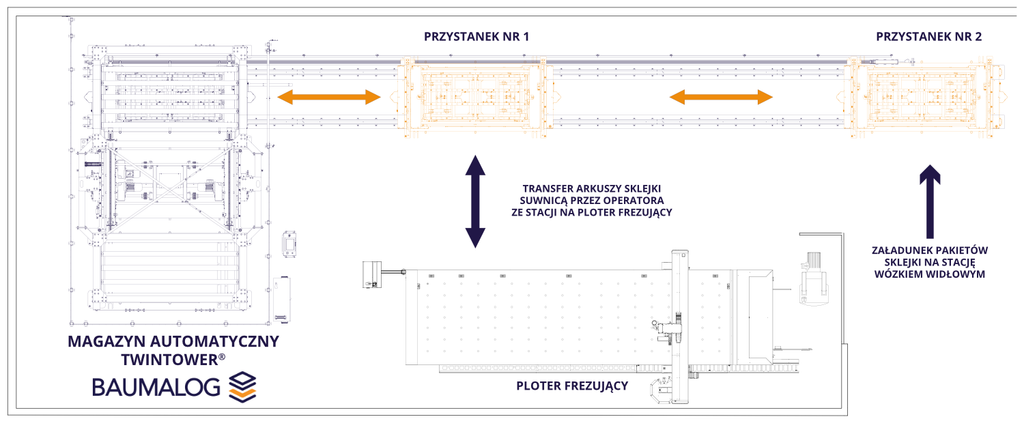
The operator removes single boards with an overhead crane with a vacuum gripper. Before the project, the plotter operator waited about 30 minutes for material. After the project, they wait just under 3, which is 90 percent less, and no longer have to negotiate with the forklift driver.
On a longer route, however, the question of power supply comes up. In the classic solution, cables run in a cable carrier, and the further the station travels, the more space the carrier needs on the opposite side. Even when the carriage is standing in the storage system doing nothing.
If the track runs along a wall, this bothers no one. If it runs across an open hall, a cable carrier sticking out beyond the rack footprint can conflict with traffic routes or with the machine layout. And that is usually when the battery conversation starts.
A long run across the hall: a battery-powered station
When the cable carrier becomes a problem, we simply drop it. The station gets battery power, and all that remains in the floor is a track flush with it.
Charging takes place automatically in the storage system, while the station is waiting for the next shelf anyway. The power source changes, not the way it is operated.
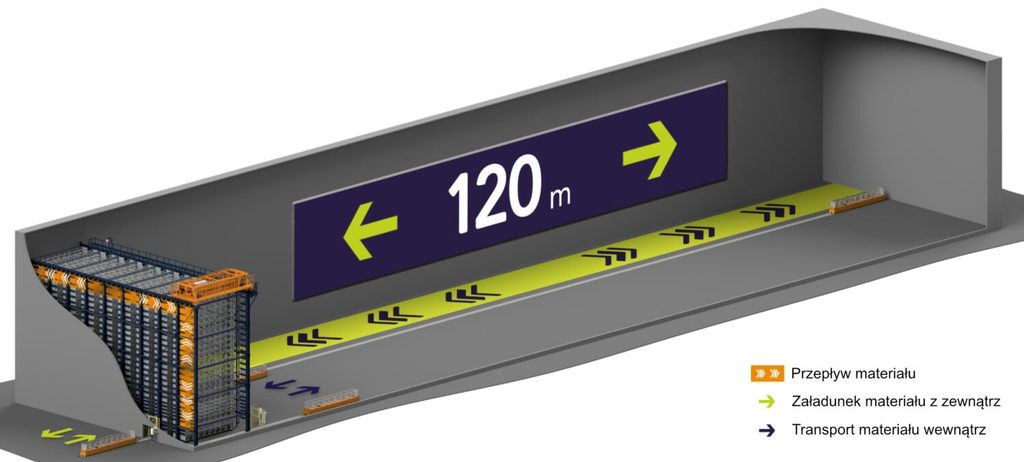
A good example of the scale such a solution can reach is the BridgeTower system at Metaltech-Piasecki. One of the stations, working inside the hall, has a track 100 meters long. Here we opted for batteries and safety scanners that allow it to travel at up to 0.6 m/s. As standard, it carries material up to 7 meters long, and with a frame for oversized material up to 12 meters.
When a fixed track is not enough: transport with AMR
A long distance alone does not mean you need AMR. If material moves between fixed points and the route can run in a straight line, a track-based station is usually fully sufficient and easier to maintain.
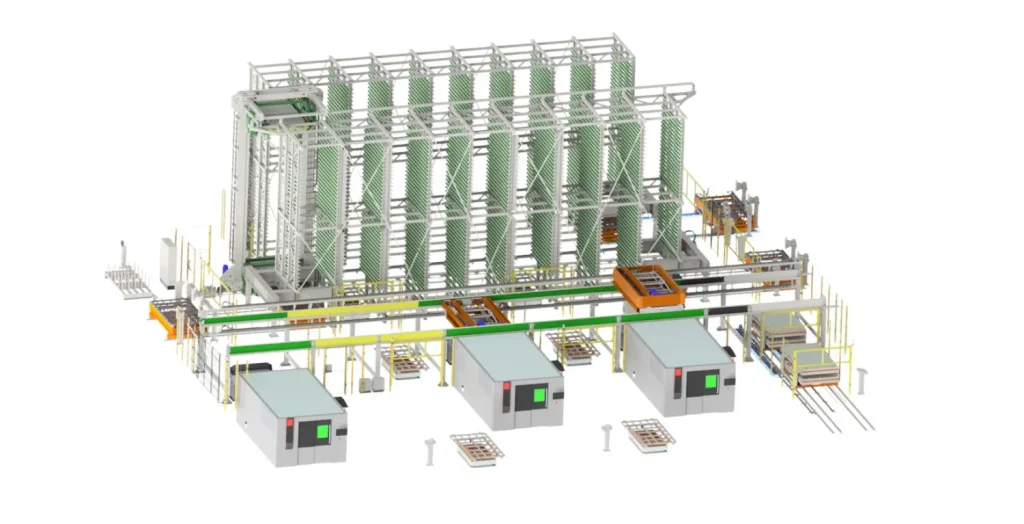
AMR wins where the route gets complicated. It has to go around machines, travel between areas of the hall or serve many scattered pickup points. It needs no rails and can work in different parts of the plant, including those that do not yet exist on the floor plan.
Which transport should you choose? Comparison
| Solution | Typical distance | Floor works | Power supply | When it makes sense | Relative cost |
|---|---|---|---|---|---|
| Shelf on the lift | 0 m | none | from the storage system | the workstation is next to the storage system, material is taken by hand or by overhead crane | lowest |
| Fixed table next to the storage system | up to a few meters | minimal | from the storage system | a single pickup point, transfer to another machine | low |
| Station with a short travel | a few meters | track | cable carrier | a local pickup point, loading and replenishment | medium |
| Station on an extended track | from 10 to 30 m and more | track flush with the floor | cable carrier | fixed stops at the machines, a straight route, preferably along a wall | higher |
| Battery-powered station | from 30 to 100 m | track flush with the floor | battery, charging in the storage system | a long route across an open hall, crossing traffic routes | high |
| AMR | any | no track | battery, charging in the storage system | a route that is not straight, many scattered points, a layout that will change | high |
A longer route requires properly matched safety
A longer route also means a larger area in which a station carrying a heavy shelf moves. We choose the safety measures to suit the route, the surroundings and the way the operator uses the system.
Depending on the solution, we use barriers and fencing, enabling buttons and safety scanners mounted on the station, among other measures. The scanners can detect a person or an obstacle on the route and slow down or stop the carriage accordingly.
Several methods often work together. A short travel in a controlled zone is secured differently from a station that crosses the hall and its traffic routes. The safety system is therefore part of the transport concept, not an add-on chosen at the end.
Planning an automated storage system or want to connect an existing system with more machines? Contact us: show us your layout and tell us how material flows today.