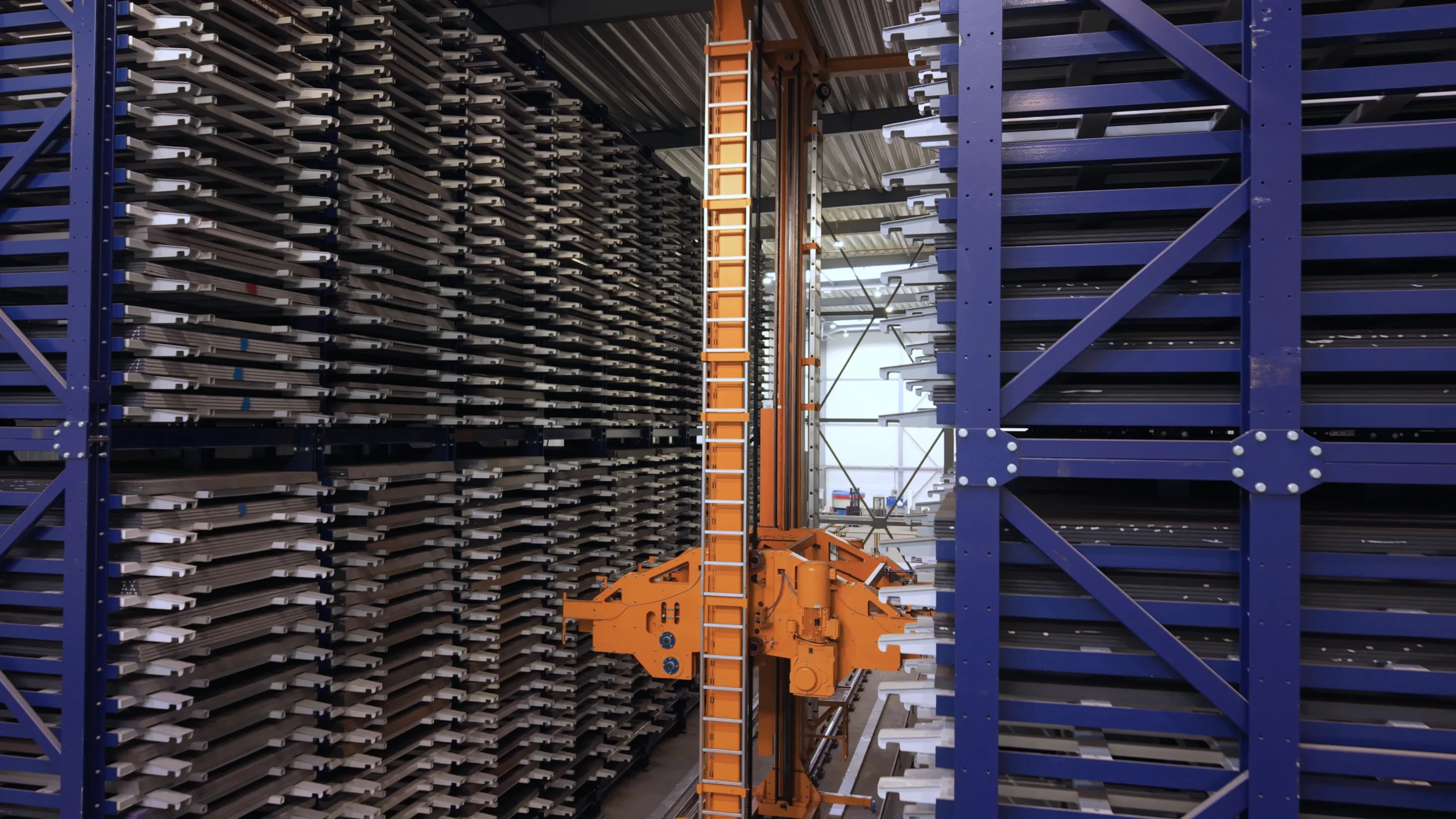
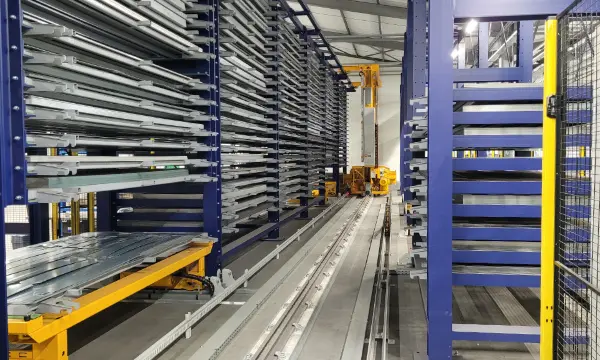
How many shelves in an automated storage system should go to cut parts?
In this post we describe how the Baumalog system manages shelves for raw material and cut parts in storage systems working with laser cutter automation.

Baumalog
16 / 11 / 2026
An automated storage system next to a laser cutter holds two kinds of material: raw metal sheets and cut parts waiting to be sorted. The problem is that cut parts can overlap: a small part can potentially tip up and even stand upright on the shelf. So do some of the shelves have to be taller? And if so, how many?
Below we describe how the Baumalog system manages shelves for raw material and cut parts in storage systems working with laser cutter automation.
Where the extra space comes from
We do not want to raise the height of all shelves for cut parts: that would reduce the load capacity and flexibility of our systems. That is why, as standard, each shelf holds material up to 90 mm high, and only some locations take shelves with material up to 200 mm. Taller locations are available in every storage system for structural reasons: they are created where the beams of the structure run.
That is exactly where we dynamically move shelves on which tipped-up parts exceed the maximum height
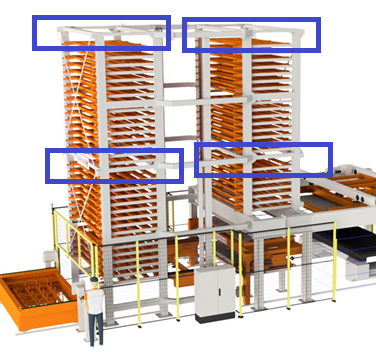
Smart Height Control System: you change the split while the system is running
One full shelf of raw sheets usually takes up two or three shelves of cut parts after cutting. How many are needed in a given week depends on what is being cut at the time and on how quickly the parts are collected for further processing. With a fixed split of the storage system, some shelves would stand empty while others would be in short supply.
Our system assumes that all shelves in the storage system are the same. Depending on the configuration, they can serve as shelves for raw sheets or for cut parts. The purpose of a shelf is changed on the operator panel. It works both ways, so the ratio between raw material and cut parts can shift as production changes.
The system manages the locations of shelves with cut parts while the laser is working, so it has no effect on the production rate.
How does the system know which shelves to move?
The height of the material is measured several times. The first measurement takes place while the laser cutter is being unloaded. When the parts exceed 70 mm, the shelf is considered full and the system brings the next empty shelf. The threshold is 20 mm lower, which leaves a margin for parts that shift or lift on the way to the rack.
A second measurement, before the shelf goes into the storage system, checks whether the full shelf has exceeded 90 mm. If it has, it goes to a taller location.
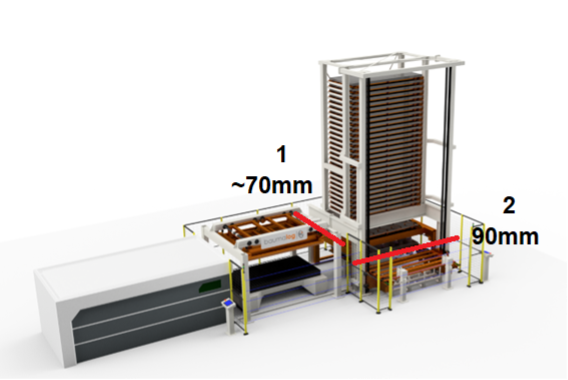
If all taller locations are occupied, the shelf does not go back into the rack.
- In MonoTower type systems, the lift brings it down to the operator
- In systems with stations, such as TwinTower, the shelf moves out to the unloading station and the loader gets the next empty shelf
Only material above 200 mm stops the system and requires operator intervention.
What this means for your production hall
Splitting the storage system between raw material and cut parts is not a decision you make once, when you place the order. It changes along with production. The more short runs and different orders there are during the day, the harder it is to predict in advance how many shelves the parts will take up. With our system, you do not have to be a fortune teller.
Are you planning to automate a laser cutter, or do you have a storage system that is always short of shelves for cut parts? Contact us: tell us what you cut and how long the parts wait to be collected, and we will show you how to arrange the shelves in your system.