Industry 4.0: what is it and how do we understand it? Key facts about the fourth industrial revolution
Industry 4.0 is a term referring to the fourth industrial revolution, which began at the start of the 21st century. From that moment, digital solutions that expanded the possibilities of simple automation started entering production halls. Although the fourth industrial revolution has been going on for quite a few years, it is still at an…

Baumalog
01 / 06 / 2023
Industry 4.0 is a term referring to the fourth industrial revolution, which began at the start of the 21st century. From that moment, digital solutions that expanded the possibilities of simple automation started entering production halls. Although the fourth industrial revolution has been going on for quite a few years, it is still at an early stage. Many people working in industry in the broad sense may still not know what Industry 4.0 is and how the term can be understood in practice. In the article below, we explain what Industry 4.0 is and how we see it in our company.
What is Industry 4.0?
Industry 4.0 is the popular name for the fourth industrial revolution: a new phase of industrial development that uses advanced digital technologies combined with automation to transform production processes into more autonomous and efficient ones. The main features of Industry 4.0 include:
- Connecting the physical and virtual spheres of production
- Use of artificial intelligence and machine learning
- Integration of machines and production processes through digital technologies and the internet (IoT)
- Human-machine interaction (HMI technologies, Human-Machine Interface)
- Data analysis (Big Data)
These are just some of the features of Industry 4.0, which will certainly keep evolving in the coming years, adding new technologies and applications. The number of companies deciding to implement digital solutions in their production areas is also growing.
Industry 4.0: key technologies
When discussing Industry 4.0, it is impossible not to mention a few key technologies that are being used more and more often. We also use innovative solutions in our products, which make it possible to digitize a large part of production in manufacturing companies and beyond. These technologies are key to building a competitive advantage in the changing environment many companies face today.
Integration of machines and systems in the company
The concept of the Internet of Things (IoT) as a digital network of interconnected objects integrating with the physical world has existed for over 20 years, although its practical use on a wider scale has only become visible recently. In industry, where an entire machine park operates in a single hall, network connectivity helps integrate different machines, enabling diagnostics and monitoring of safety and of the processes between them.
Thanks to Smart WMS software, it is possible to connect to an ERP or WMS system or the software of a processing machine from another manufacturer. Integration with other software is not an obstacle and does not lower process quality; instead, it allows full and efficient exchange of information between machines and insight into the production data of connected equipment.
Process visualization on a computer screen
The production process is often highly complex and takes place over a large area. With a view of it on an industrial computer or operator panel, we can see the individual stages in one place and analyze production data from different production phases. The software created and designed by our specialists enables simple visualization of production, data analysis and reporting according to the company’s needs. The whole process is created in the spirit of Industry 4.0.
Insight into data from production machines also allows fast and effective diagnostics. Thanks to their sensors, smart devices can themselves signal the need to replace a component or carry out an inspection.
Data analysis and presentation
An important feature of the fourth industrial revolution, which has significantly changed the face of production, is the ability to use production data from different machines. This makes optimization of production processes possible. From the point of view of using data, the way data is presented is also key.
Our software allows reports configured to the company’s needs to be created. Reports can be supplemented with additional charts and tables to extract the most important information. Reports can cover the performance and utilization of individual machines as well as stock levels in the automated storage system.
How does the fourth industrial revolution differ from the third?
Automation, which is talked about a lot today, has played an important role in industry for several decades. The previous third industrial revolution, also called Industry 3.0, also covered machine automation and software-based control. However, it is worth highlighting a few important differences between the third and fourth industrial revolutions.
Industrial production automation in the third industrial revolution was based on programmable logic controllers (PLC) and numerically controlled (CNC) machines. These technologies allow computer control of machines and enable communication between them. However, they do not include the extensive digital layer that Industry 4.0 covers. The previous era in industry also did not involve using data to optimize production. Advanced yet easy-to-use software enables complete data analysis and provides simple, clear presentation that makes it easier to monitor the performance of individual machines and the whole production.
How do we at Baumalog help companies implement Industry 4.0 solutions?
Our systems fit into the ideas of Industry 4.0, supporting companies on their path of development in the digital revolution. Each of our solutions connects the physical functionality of machines with the virtual space, enabling simple, fast and efficient operation. Here are a few examples of how we implement Industry 4.0 solutions.
Laser cutter automation: machine integration and Industry 4.0
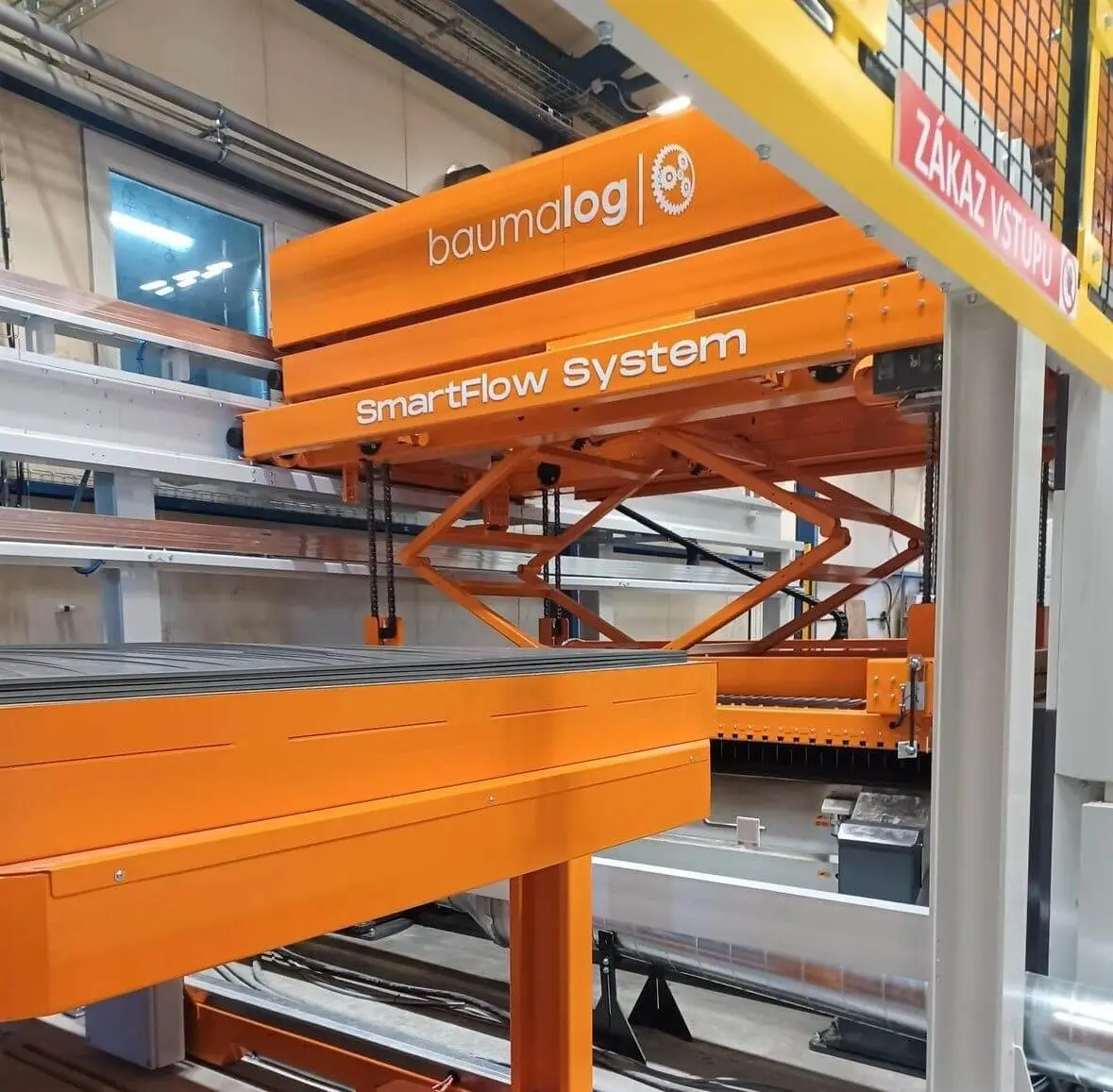
SmartFlow System is our flagship product, designed for efficient flow of metal sheets to the laser cutter. All components of the process are:
- Automated storage process
- Material flow from the storage system to the transport system (MultiLoader)
- Automatic loading and unloading of the laser cutter
- Return of cut parts to the automated storage system or delivery to the sorting area
A key aspect of SmartFlow System is integration with the laser cutter. Our systems can integrate with laser cutters from almost any manufacturer without compromising the quality of the whole process. Thanks to communication between the machines throughout the system, production downtime can be eliminated and the full potential of the laser cutters can be used.
See the full range of Baumalog automated systems: Baumalog automation
Storage automation: a major process simplification
Storing material (metal sheets, long, heavy elements and large tools) is a challenge that can also be optimized with modern solutions. Our storage systems come as standard with software that enables comprehensive warehouse management.
The key benefits of Baumalog automated storage systems are:
- storage space savings of up to 90%
- more efficient material flow inside the warehouse
- ongoing monitoring of stock levels
- greater work safety
- easy operation from the operator panel
To learn more about our storage systems, visit the offer page: Baumalog automated storage systems
What does Industry 4.0 mean for your company?
Industry 4.0 solutions are becoming increasingly popular in many industries, especially in production, logistics, transport and urban management. Innovative solutions in automated systems are an opportunity to improve many processes in a company. In production and storage, machines that integrate and communicate with each other can make full use of production capacity. Taking the laser cutter as an example, automated systems can increase laser cutting time to 90%, minimizing laser cutter idle time and also allowing the machine park to work at night or at weekends without operator supervision. Today, process autonomy is within reach. It is worth taking the opportunity to improve production processes and build a competitive advantage by increasing efficiency and optimizing key processes in the company.