Does automation only pay off with long runs? HMLV production calls the bluff
In HMLV production, the real cost is not the cutting itself. It is everything in between: finding the right sheet, bringing it to the machine by forklift, loading, collecting parts, putting the remnant away.

Baumalog
15 / 09 / 2026
Monday, 7:00 a.m. The laser is cutting eight stainless steel parts. Two hours later, mild steel has to be on the table: three pieces, urgent. In the afternoon, aluminum, a run of twelve. And tomorrow? Tomorrow a completely different list will come in. If this sounds familiar, your production works in an HMLV model, high-mix low-volume: great variety, short runs, constant change.
And you have probably heard more than once that automation is not for you. That it “only pays off with long runs”. Two projects, at NETECS in Poland and ALASER in France, show that the exact opposite is true. It is with short runs that automation has the most to offer.
Short runs, a long list of problems
In HMLV production, the real cost is not the cutting itself. It is everything in between: finding the right sheet, bringing it to the machine by forklift, loading, collecting parts, putting the remnant away. With long runs, these operations are spread over hundreds of pieces. With a run of three parts, they can take longer than the cutting itself.
Then there is logistics. The more material indexes, the more racks, the more searching and the more transport routes occupied by forklifts. The more frequent the product changes, the more people are needed to keep up with material deliveries to the machines, and the more the production plan depends on whether everyone actually came to work that day.
A myth from the era of long runs
Where did the belief that automation requires long runs come from in the first place? From the days when automation really did mean a rigid line: set up for one product, expensive to change over, profitable only after thousands of repetitions.
An automated sheet metal storage system integrated with a laser cutter works on the opposite principle. Its strength is not repeatability, but instant access to any material. A change of product does not require a changeover: the system simply delivers a different shelf. The order queue can change during the day, and after cutting the material goes back to the storage system and waits its turn instead of blocking the workstation. These are exactly the features HMLV production needs most.
Let us see what this looks like in practice.
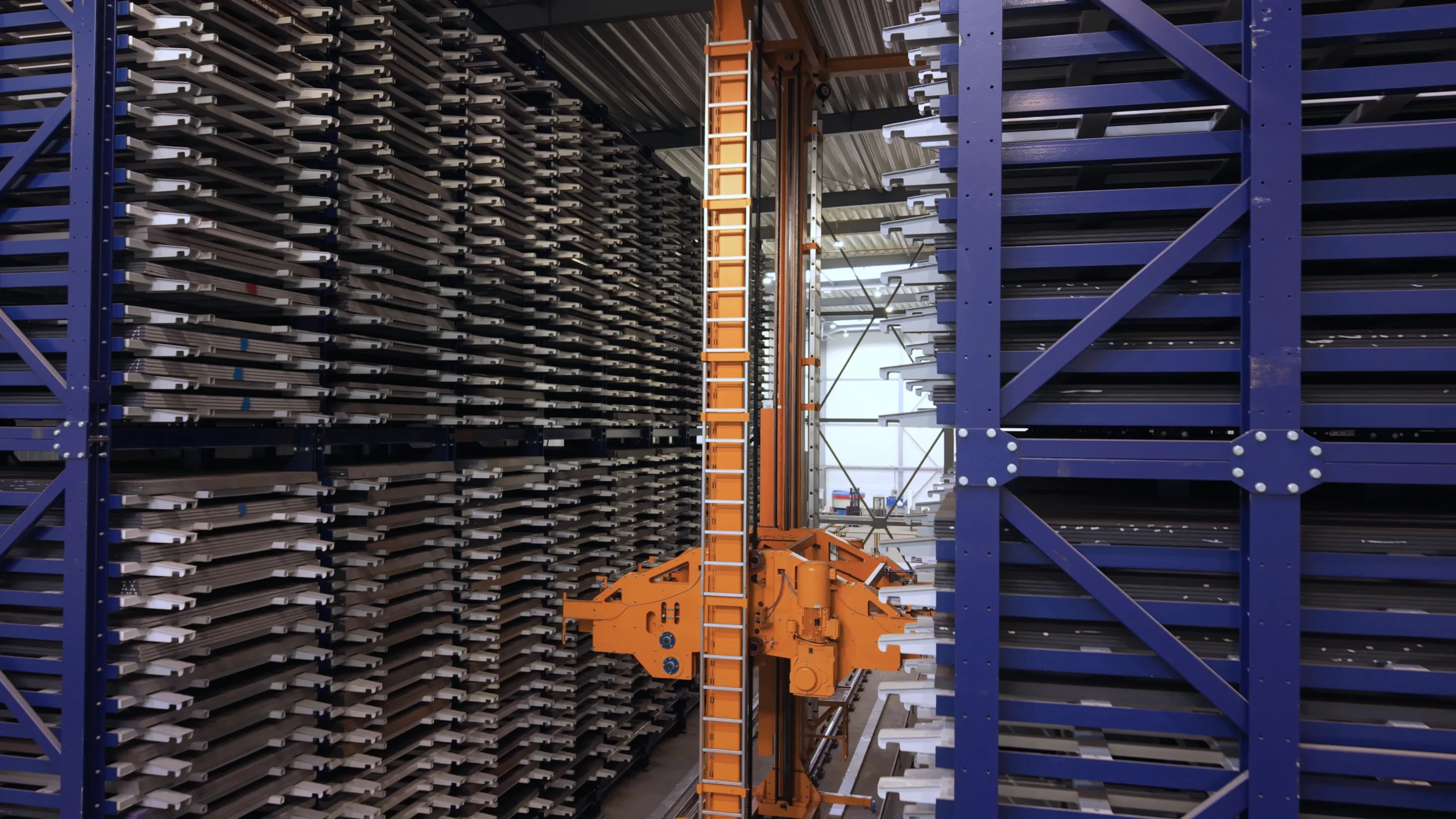
NETECS: almost 750 tons of sheet metal within reach of the stacker crane
At NETECS, we launched an automated sheet metal cutting line based on two TRUMPF laser cutters: one with fully automatic loading of raw material and unloading of cut parts, and the other with automatic material delivery close to the work table.
At the heart of the system is a MultiTower automated storage system with a stacker crane: 130 shelves with a capacity of almost 750 tons of sheet metal. All the elements (storage, sheet transport to the cutter, part collection) are integrated, and our software manages the order queue and work planning, working with the CAD/CAM system responsible for nesting.
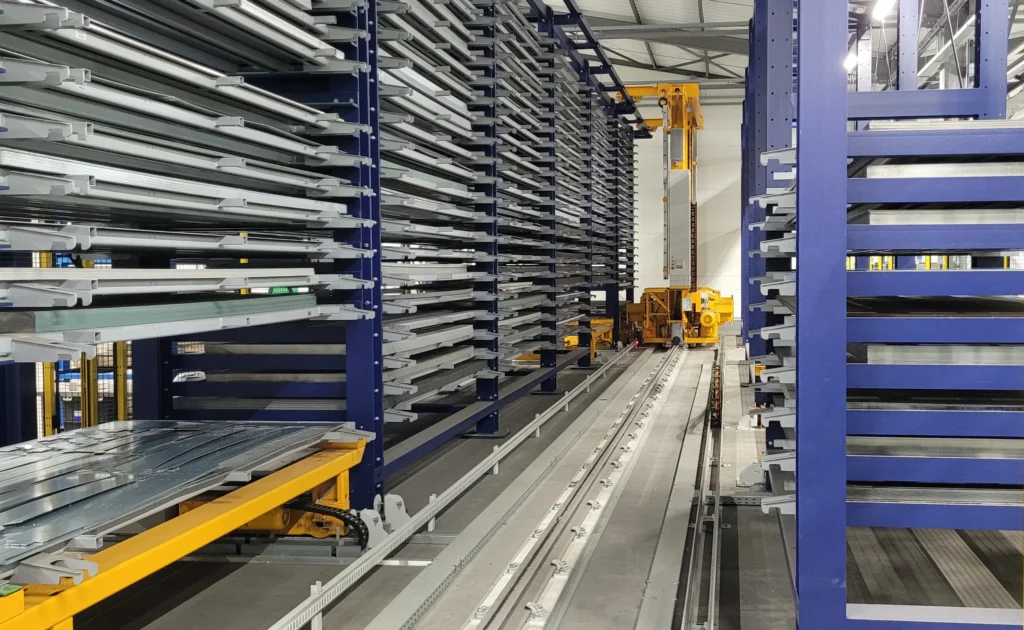
The results? Higher production efficiency and profitability, forklifts in the cutting area reduced to a minimum, fewer operators involved in the process, and readiness to handle short-run and one-off orders efficiently.
ALASER: any material in 3 minutes in a cramped hall near Bordeaux
ALASER from Canejan near Bordeaux provides contract cutting of aluminum, steel and stainless steel: a classic job shop where the product mix changes from hour to hour. The challenge was twofold: to make production more flexible in an HMLV model and to fit all the automation into an exceptionally limited hall space.
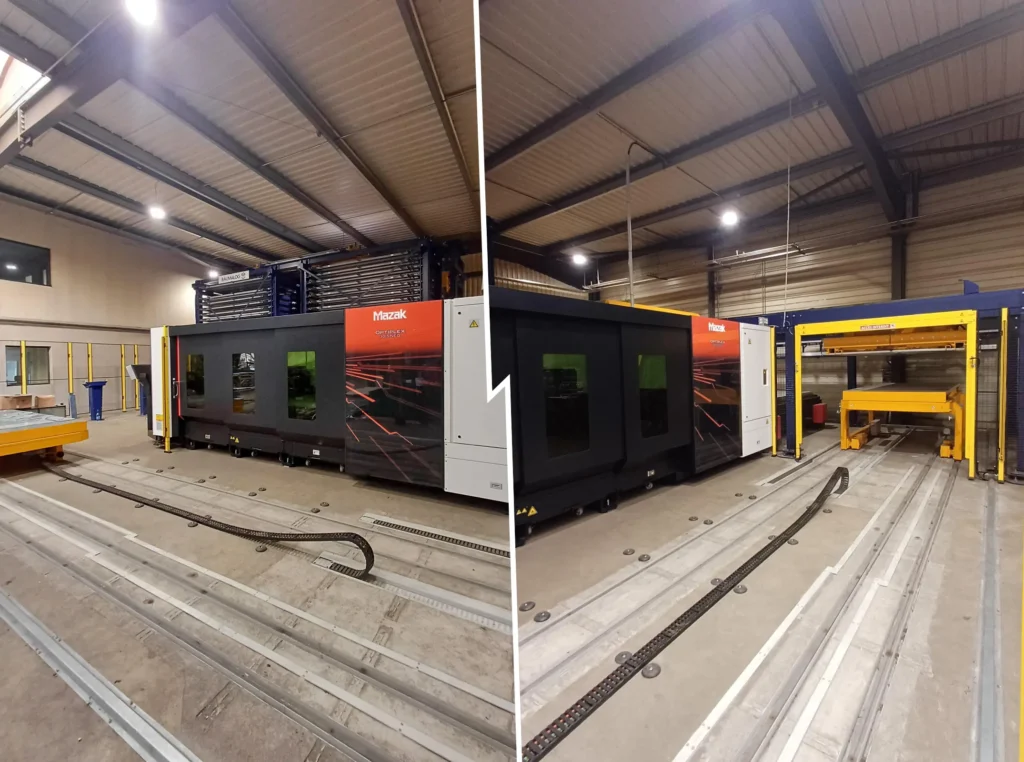
The solution was a SmartFlow System line: a TransferTower automated storage system with 73 shelves and a total capacity of 219 tons, and a MultiLoader for loading and unloading the cutter tables, integrated with a 15 kW Mazak Optiplex laser and the customer’s CAD/CAM software. The two-level access point and the MultiLoader were designed so that the system can be expanded with a second cutter in the future.
One thing is worth pausing on: ALASER deliberately chose an independent automation manufacturer. This gives it full freedom to integrate laser cutters of any brand, without depending on a single machine supplier.
The numbers speak for themselves: access to any type of sheet metal in 3 minutes, loading of single sheets at up to 40 pieces per hour, the ability to buffer material after cutting without sorting it on an ongoing basis, and work at night and at weekends without the constant presence of an operator. The owners emphasize that the installation delivered immediate results: order lead times were dramatically shortened, and the modern, powerful laser is finally working to its full potential.
What you really buy when you automate HMLV production
These two projects are a thousand kilometers apart and differ in storage system size and laser brand. What they have in common is this: in both cases, automation did not make production more rigid, but more flexible. Material stopped waiting for a forklift, an operator and a free spot at the machine, and started to flow: from the storage system to the table, from the table to the buffer, from the buffer to the press brake or to shipping. The order of this movement is managed by our software, so changing priorities in the middle of the day is a change in the order queue, not a logistics rescue operation on the shop floor.
At Baumalog, we put it briefly: Flow matters. And the shorter the runs and the more frequent the changes, the more it matters.
How much time do your lasers spend waiting for material today? If you want to check how automation would work in your production model, contact us.