Does laser cutter automation have to come from the laser manufacturer?
You buy a laser cutter and get an offer for automation from the same manufacturer. One logo, one contract, one service. Sounds like the safest route?

Baumalog
19 / 08 / 2026
You are buying a laser cutter. The salesperson shows you the machine, the cutting technology and the technology software, and at the end proposes automation from the same manufacturer. It sounds like the safest route: one logo, one contract, one service, so everything will probably work together better.
It is worth checking exactly what you are buying, though. A laser with automation is still two machines, not one, regardless of what is printed on the housing.
Below we write about how to choose laser cutter automation and what questions to ask the supplier, instead of basing the decision on the brand. We do not settle whose laser cutter is the best, because that depends on the material and the parts you produce. Nor do we compare specific loader models.
The same logo does not connect two machines
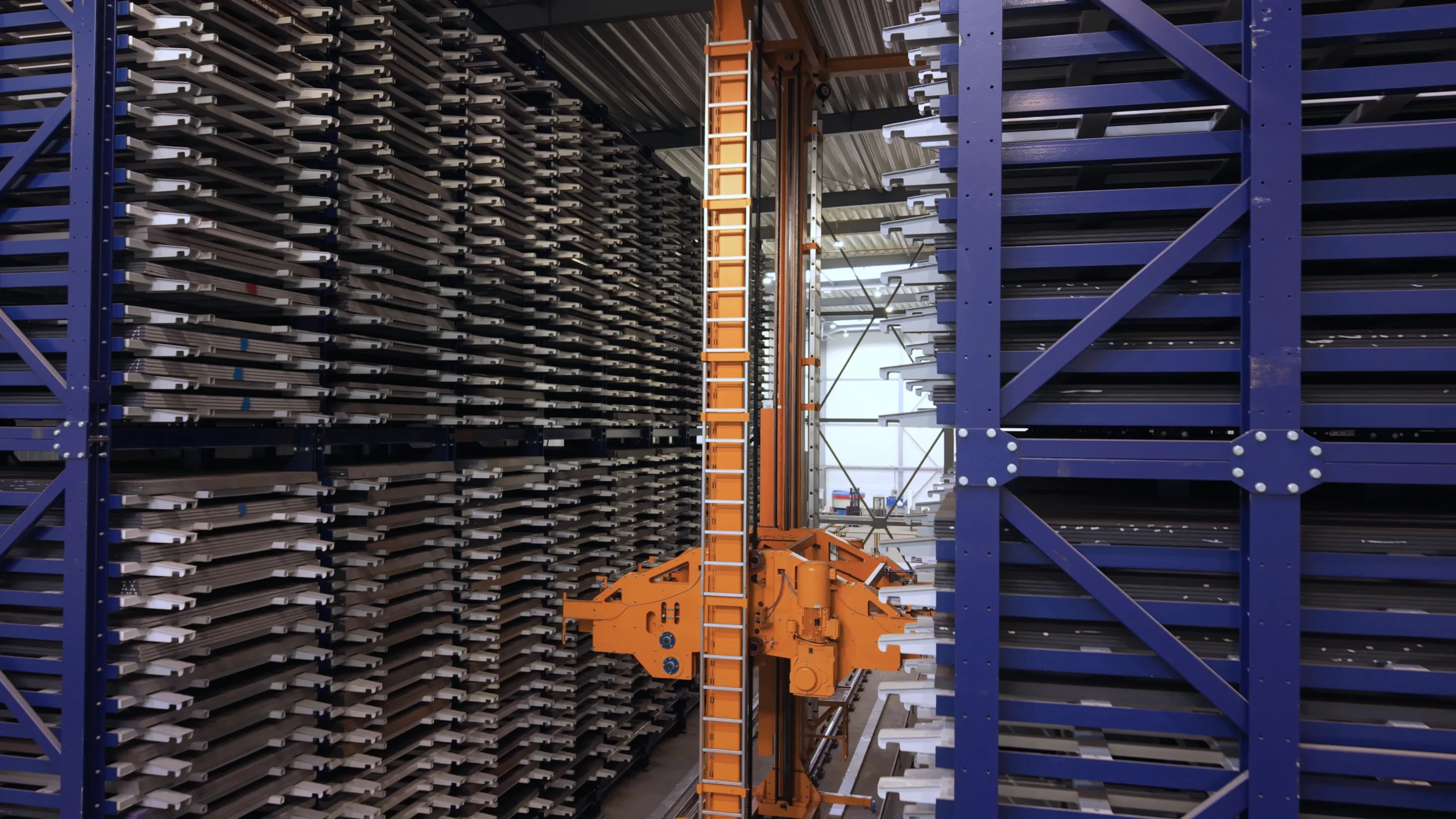
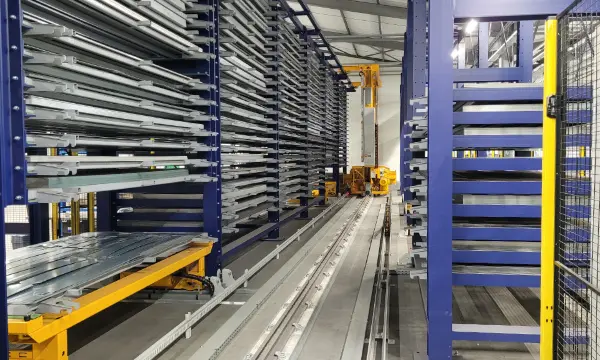
Take the same laser model sold with and without automation. The laser cutter does not change. It has its own control system, runs the cutting program and manages the technology. Next to it comes another machine, responsible for feeding the sheet and collecting cut parts. If you add an automated storage system, you already have at least three machines working together.
Each of them has its own control system, performs different functions, communicates through a defined interface and requires an agreed sequence of operation. They may have separate safety systems. They are commissioned and tested as elements of one line.
Even within one brand, individual parts of the system may come from another division, a group company, a technology partner or an OEM supplier. There is nothing wrong with that. It only shows that a common logo on the housing is no proof that everything was designed and tested by one team.
So the right question is not whether both machines have the same logo. It is whether they are properly integrated and who takes responsibility for the whole system working.
Myth: third-party automation cannot be integrated well
Most modern industrial laser cutters are designed to work with external equipment. For this purpose, the manufacturer provides an interface: a set of signals, commands and statuses that allow the machine’s work to be coordinated with the loading and unloading system.
An independent integrator uses the same official interface, often exactly the one the laser manufacturer’s own solution connects to. What matters to the laser cutter’s controller is whether the right signals appear in the right order and at the right time, not the logo on the machine standing next to it.
This does not mean you can connect any automation to any laser. What is needed is: an available interface of the right scope, knowledge of the manufacturer’s protocol, properly developed sequences, an agreed division of responsibility, testing of the whole process and the integrator’s experience. Integration is a specific engineering task to be done, not an argument that in itself favors one brand.
Our systems work with laser cutters from manufacturers such as TRUMPF, Bystronic, Amada, Eagle, Mitsubishi, Mazak, Durma, BLM, Salvagnini and others, including when machines of different brands work in one system. We wrote the Flower software as universal precisely because our customers’ machine parks are rarely single-brand.
Example project
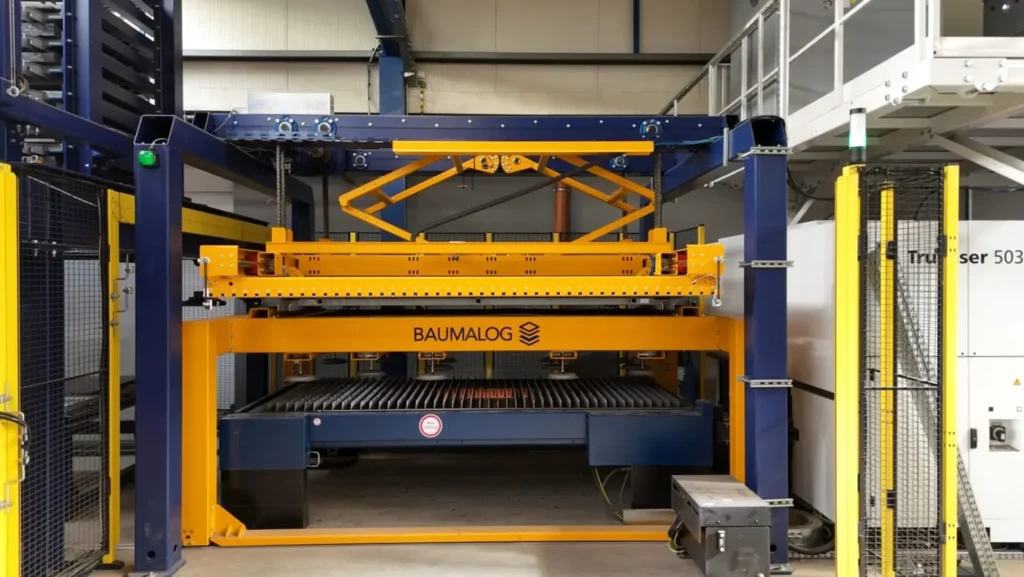
At Marbo Sport in Starachowice, two TRUMPF TruLaser 5030 laser cutters work on 120 square meters. At the heart of the layout is a TwinTower storage system for 66 tons of sheet metal and parts; the left laser is served by a Loader 3015 and the right one, because of the specific space, by a MultiLoader. The whole system is managed by Flower Pro, integrated directly with the CAD/CAM software of the TRUMPF machines.
The integration goes so deep that if one laser stops, the system can re-plan part of the work to the other machine, and the plan can be adjusted on the fly without stopping cutting. Before the project, the plant processed about 1,500 sheets a month. After the project, 6,000, and loading and unloading logistics became six times faster. In the same space.
The condition to set for the supplier: someone is responsible for the whole system
This is the most important caveat of this article. The fact that the automation manufacturer is independent is not an advantage in itself.
An independent supplier must have experience integrating lasers from different manufacturers, know their interfaces and limitations, be responsible for commissioning the complete process, test how the machines work together, clearly define the division of responsibility between the parties, provide service for the entire system delivered and be the first point of contact when a problem arises.
Because the worst answer you can hear during downtime is: our machine is working correctly, please call the manufacturer of the other machine. If the sheet does not reach the laser table, the automation supplier should diagnose the whole process and coordinate the solution, regardless of exactly where the boundary between the machines lies.
This is a criterion for choosing an integrator, not a reason to narrow the choice to the laser cutter brand from the outset. If the interface is available and responsibility is written into the contract, you can safely compare solutions on what they actually do.
You buy automation for longer than a particular laser
Cutting technology develops fast. Source power increases, and heads, process parameters and software capabilities change. Companies sell older laser cutters and replace them with newer ones or ones better suited to their current production.
A large automated storage system and the material transport that goes with it have a completely different life cycle. It is plant infrastructure involving foundations, layout, tracks and integration with IT systems. It is not replaced every time a new machine is bought.
If the automation is prepared for such a change from the start, you replace the laser and the integration elements, while the storage system, transport system, access points and flow management software stay. The new laser cutter may come from the same manufacturer, but it does not have to. The choice of the next machine is then once again based on technology, performance, service and purchase terms, not on the need to fit the automation bought many years earlier.
The best laser and the best storage system rarely have the same logo
The manufacturer whose laser cutter best suits your technology does not necessarily also have the best storage system, the most flexible transport and software matched to the whole process. These are simply different products and different competences.
If you buy the whole package just because of the laser brand, you may accept automation that makes worse use of the available space, has too little room for expansion, serves only one group of machines or offers simplified storage functions. A good choice of laser cutter should not force a compromise in the other parts of the system.
Several lasers, different brands, one flow
A plant does not have to base its entire machine park on one brand. One laser cutter may be best for thin sheets, another for thick ones, and a third comes from an earlier stage of the company’s growth and still works well.
Independent automation makes it possible to connect such machines in a shared system. Material lies in one storage system, and the system manages its delivery to the right laser. Planners work from one view of stock levels, and operators handle everything the same way. From the plant’s point of view, you no longer have three lasers with three separate automation systems and three islands of material, but one cutting cell.
A hall is rarely empty and rectangular
Standard solutions work well in standard conditions. But existing halls have columns, gates, other machines and installations, and traffic routes running through the middle.
The laser manufacturer’s catalog automation usually provides for a few defined configurations. A design built from scratch makes it possible to fit the system to the columns and hall structure, existing machines, available height, the direction from which material arrives and what the plant plans to add in three years. At Marbo Sport, we fitted two lasers, a storage system and full loading automation into 120 square meters precisely because the layout was designed for that hall, not from a catalog.
We fit the system to the hall and the process, not the hall to the one available version of the system.
How material gets from the storage system to the machine is described separately, along with a comparison of track stations, battery stations and AMR transport.
The software has to see more than the laser table
The laser cutter manufacturer’s software manages the technology in great detail: NC programs, cutting parameters, nesting and machine status. However, its storage functions are often limited to what is needed to run the laser itself.
In an extensive system, that is not enough. You need to know not only what material is to go on the table, but also which batch to take it from, what certificate and heat number it has, whether it is already reserved, how to convert kilograms into sheets, where to put the material after cutting, what to do with usable scrap, which machine should carry out the task and how to change priorities without stopping production.
That is why we are developing Flower as software covering the entire flow. Flower Store is responsible for warehouse management, Flower Pro for the cutting cell and material movement between machines, and Flower Link for the connection with the plant’s systems. For a laser manufacturer, the most important product is cutting, and that is how it should be. For us, the most important thing is the flow of material.
ERP integration is not just sending an order number
Connecting automation with the ERP requires understanding how information flows in the company. You have to decide when material is reserved, when it is issued, how to account for actual consumption, how to handle batches, certificates and documents, and what to do in the case of corrections and process exceptions.
A technical interface alone does not solve this. First the process has to be analyzed, and only then described with the data being exchanged. That is why our support includes analysis of the business processes being integrated, API configuration on the Flower side, agreeing the data exchange model, integration testing, support for the external system’s integrator during commissioning and dedicated adapters for non-standard scenarios.
A laser manufacturer may provide data exchange capabilities. However, analyzing the complete warehouse and production process is usually not its core area, while for a supplier responsible for the storage system and material flow it should be an integral part of the project.
When the laser manufacturer’s solution is a good choice
It will be, and there is no point pretending otherwise. If you need a simple loader serving one laser cutter, without a storage system, without extensive planning and without integration with the plant’s systems, the laser manufacturer’s catalog solution can do the job very well. It is ready, proven and matched to the specific machine.
The advantage of an independent supplier grows with scale: when a large storage system is added, when there is more than one machine, when lasers from different manufacturers work together, when the layout requires an individual design, when full material management and a connection with ERP, MES or CAD/CAM are needed. The more of the process surrounds the laser, the less cutting alone decides.
What to compare before you sign the contract
| What you compare | Laser manufacturer’s automation | Independent automation supplier |
|---|---|---|
| Scope of a typical solution | a few standard configurations for its own machines | from a single loader to a system with a central storage system and many access points |
| Replacing the laser years later | the new machine is usually the same brand | the storage system, transport and software stay; you replace the laser and the integration elements |
| Lasers of different brands in one system | rarely provided for | a standard project scenario |
| Fit to the hall layout | choice from the available versions | design around columns, gates, existing machines and planned expansion |
| Storage functions of the software | subordinate to running the cutting | batches, certificates, heats, reservations, usable scrap, unit conversion |
| Integration with ERP, MES, CAD/CAM | interface available, analysis of the warehouse process rarely the focus | one of the main areas of the project |
| Responsibility for commissioning | one supplier for the whole line | also one supplier, but ask directly and put it in the contract |
| When the choice is obvious | a simple loader, one laser cutter, a standard layout | a large storage system, several machines, complex flow, expansion plans |
Do not buy independent automation just because it is independent. But do not reject it only because it has a different logo on the housing from the laser cutter. In the end, what matters is not the number of brands in the project, but whether the whole system works like one machine.
Planning automation for a laser cutter or a whole cutting cell? Contact us